How to Dilute Tangerine Oil: Ratios and a Patch Test
"Two percent" sounds exact, but two percent of what, counted how? Anyone who has measured out a skin blend knows the muddle: one chart says 18 drops, another says 12, and both are called a 2% dilution. The fix is simple once you see where the confusion comes from, and it is the whole secret to diluting tangerine oil well.
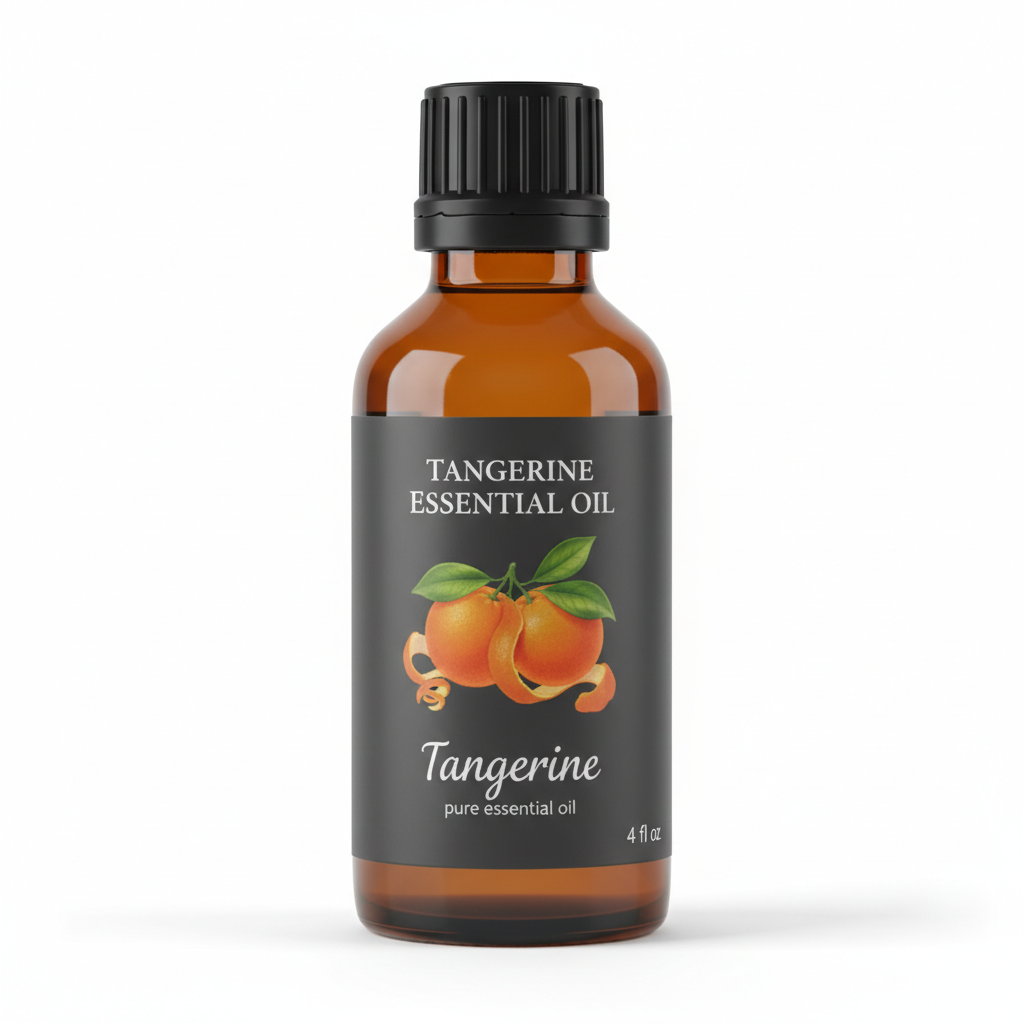
Tangerine Essential Oil
Our own Tangerine Essential Oil, in sizes from 0.5 oz to bulk.
From $12.99
Shop Now →Start with the percentage
The Tisserand Institute's rule is short and clear: do not apply undiluted essential oils to your skin. We sell tangerine oil neat, so the carrier and the maths are yours. Our dilution guidance for skin is 0.5% to 2% in a carrier oil, and we suggest starting at the bottom. We could not find a published dermal maximum for tangerine from an authority, so we treat 2% as the top of our own range rather than as a number that is safe for everyone. For sensitive skin, or anywhere near the face, we suggest staying at 0.5% to 1%; see the face oil guide for why.
From percentage to a measurement
Here is the table for 30 ml, about one fluid ounce, of carrier. The oil volume is the dependable column. The two drop columns show how the same dilution turns into different counts depending on the convention.
| Dilution | Oil in 30 ml | Drops at 30 per ml (Tisserand chart) | Drops at 20 per ml |
|---|---|---|---|
| 0.5% | 0.15 ml | 4 | 3 |
| 1% | 0.30 ml | 9 | 6 |
| 2% | 0.60 ml | 18 | 12 |
That mismatch is not an error. Tisserand's dilution chart assumes 30 drops to the millilitre, while 20 per millilitre is the convention many shops and our own "3 to 12 drops per ounce" rule of thumb follow. The Institute's review of three studies found that 20 drops weighed an average of 0.66 g each time, but that drops per millilitre ranged from about 20 to 40. Mix the conventions and you can land well off target: 12 drops counted at 30 per millilitre is only 1.33% in 30 ml, while 18 drops at 20 per millilitre is 3.0%.
Two ways to take the guesswork out
You can calibrate your dropper by counting how many drops fill 1 ml in a small graduated syringe, then using that number from then on. Or you can weigh. The Certificate of Analysis we publish gives a relative density of 0.846 for one batch, so 1 ml of that batch weighs about 0.846 g, and the 0.3 ml you need for a 1% blend in 30 ml is about 0.25 g. That is easy with a scale that reads to 0.01 g, and it is an estimate for one batch rather than a promise about every bottle.
A first blend, step by step
If you have never mixed a skin blend, start small and slow. Clean a small bottle and your work surface, pour in the carrier first, then add the tangerine at the bottom of our range, 0.5%, using the table above. Cap the bottle, tilt it gently a few times and let it sit for a minute. Smell it. It will be much fainter than the oil on its own, and that is exactly the point. A blend that smells subtle is a blend made the way it should be.
Patch test the finished blend
The American Academy of Dermatology describes a home test for any new product: apply it to a quarter-sized spot where it will not rub or wash off, such as the underside of the arm or the bend of the elbow, twice a day for seven to ten days, and use it only if there is no redness, itching or swelling. Test the finished blend in the carrier and strength you plan to use. If a reaction appears, wash it off and stop; a dermatologist can help with reactions to scented products.
Freshness matters as much as the ratio
Tangerine peel oil is mostly limonene, which reacts with air. In a six-country study of 2,900 dermatitis patients, 5.2% reacted to deliberately oxidised limonene, with centres ranging from 2.3% to 12.1%. These were patients already referred for dermatitis, so it is not a risk estimate for a gentle blend, but it is a good reason to use fresh oil and mix small batches. Our storage guide shows how to keep a bottle bright.
A note on sun
We suggest keeping sun off freshly applied areas, as cold-pressed citrus oils in general can heighten skin's sensitivity to light. For the wider picture, the Tisserand Institute says expressed tangerine contains extremely small amounts of furanocoumarins, not enough to make it phototoxic. IFRA's citrus standard lists cold-pressed tangerine at a typical 50 ppm of bergapten, which it says does not need special restrictions when the oil is used alone, against a 15 ppm ceiling in finished leave-on products for skin exposed to UV. By our arithmetic, a 0.5% blend carries about 0.25 ppm and a 2% blend about 1 ppm if the typical level holds. Our sun guide has the full picture.
Choosing a carrier
We do not sell carrier oils, so you will find one at a craft or cosmetic-supply shop or a pharmacy. Jojoba and sweet almond are the carriers we mention, and the carrier oil comparison goes deeper. For a first test, use a plain, fresh carrier you already know your skin likes. Skip skin application altogether if you have reacted to citrus or fragrance before, if the skin is broken, or if the blend is for a child; a paediatrician is the right person to ask.
Write the date, the percentage and what you used on a label and stick it on the bottle. It takes ten seconds, and it means that next month you will know exactly what is inside, how old it is and whether a change in your next batch is what you meant.
Pick the percentage, measure it the same way every time, test a small spot and enjoy a sunny, subtle scent on your skin.
Tangerine Essential Oil
Tangerine Essential Oil from our own shop, in sizes from 0.5 oz to bulk.
From $12.99
Shop Now →Sources & Further Reading
- Tisserand Institute. How to Use Essential Oils Safely. tisserandinstitute.org
- Tisserand Institute. How big is a drop? tisserandinstitute.org
- Tisserand Institute. Phototoxicity: essential oils, sun and safety. tisserandinstitute.org
- IFRA Standard 089 (Amendment 49), 2020. Citrus oils and other furocoumarins containing essential oils. ifrafragrance.org
- American Academy of Dermatology. How to test skin care products. aad.org
- Bråred Christensson J et al., 2013. An international multicentre study on the allergenic activity of air-oxidized R-limonene. Contact Dermatitis 68(4):214-223. PubMed 23510342