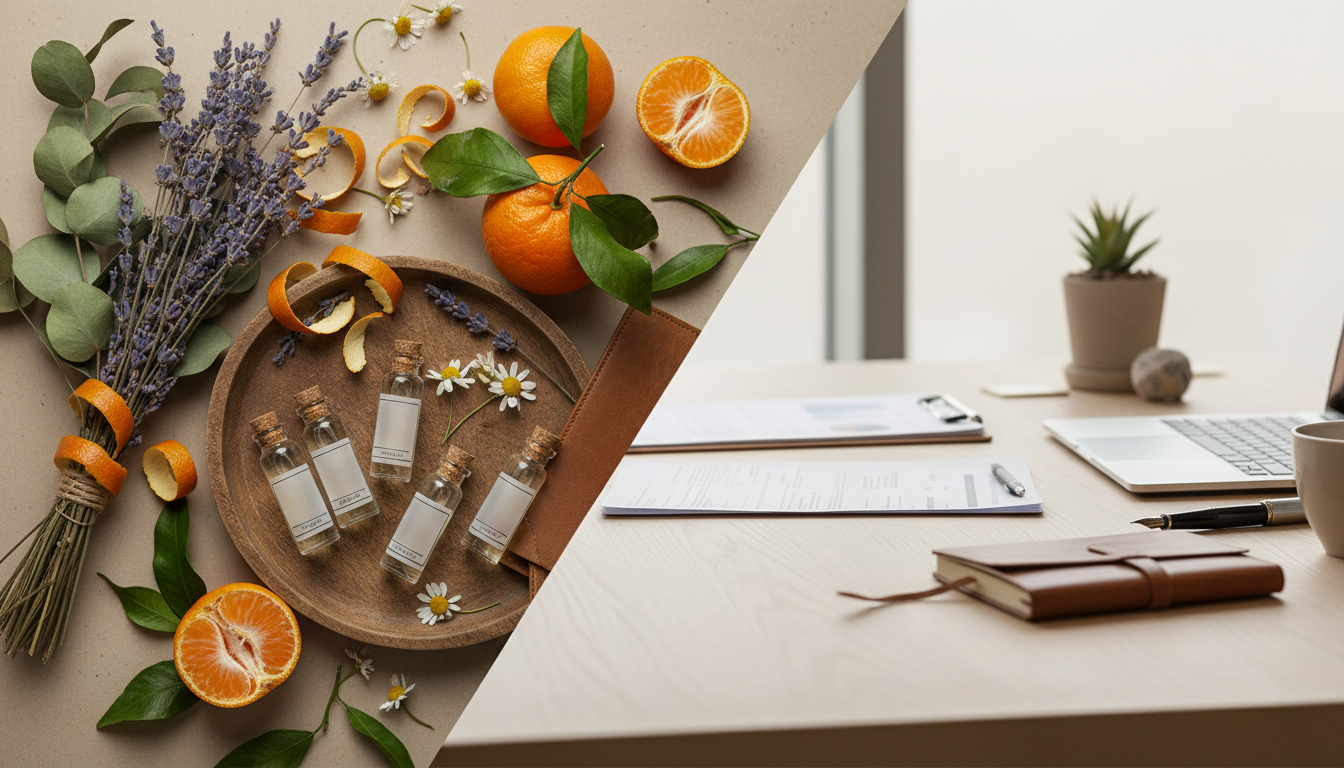
The Sunrise Blend: Our Signature Tangerine, Vanilla, and Cedar Mix
Some blends announce themselves. The moment you uncap the bottle, something shifts in the room. The Sunrise Blend is built around that exact quality: a tangerine vanilla blend warm enough to feel grounding, bright enough to lift the mood of a whole morning. It opens with the cheerful, candy-bright top note of cold-pressed tangerine, settles into the soft comfort of vanilla CO2, and lands on a dry, pencil-shaving base of Atlas cedarwood. The result smells like a sunlit kitchen in late autumn.
This guide walks through every detail of the recipe: why we chose these specific ingredients, how to build the blend from scratch, how to adapt it across a diffuser, a roller, or a room spray, and how to store what you make. If you are new to blending citrus oils into layered compositions, this is a satisfying place to start.
Why This Combination Works
A strong tangerine blend recipe needs an anchor. Tangerine essential oil is famously fleeting. Its limonene-rich top note evaporates quickly, which means a diffuser blend built on tangerine alone will shift character within the first twenty minutes. Cedarwood solves that problem. Atlas cedarwood (Cedrus atlantica) is a base note with a long evaporation window. It holds the blend open, slowing the drift so the citrus stays perceptible longer.
Vanilla CO2 extract sits in the middle of that conversation. It is not as heavy as a resinoid, not as sharp as a synthetic vanillin, and it carries a faint warmth that rounds off any harshness between the bright citrus and the woody base. Together, the three ingredients create what perfumers call a linear progression: you smell all three notes at once, but each takes a turn being most prominent depending on how long the blend has been open to air.
For a deeper look at how tangerine oil plays with other notes across the home, the complete guide to tangerine oil uses covers diffusing, linen sprays, and surface applications in full detail.
A Note on Cedarwood Variety
The cedarwood family is broader than most people expect. There is Atlas cedarwood, Himalayan cedarwood, Virginian cedarwood, and Texas cedarwood, each with a meaningfully different aroma character. The Sunrise Blend specifically calls for Atlas cedarwood (Cedrus atlantica) for one precise reason: its sesquiterpene profile, dominated by atlantones and cedrol, produces a softer, almost powdery-dry wood note rather than the sharper, pencil-box quality of the Virginian variety. That softness does not compete with tangerine. It complements it.
Himalayan cedarwood is a reasonable substitute if Atlas is unavailable, though it reads slightly more camphoraceous. Virginian cedarwood will push the blend in a drier, more austere direction. If you want the warmest version of this signature citrus blend, Atlas is the one to reach for.
Full Ingredients List
The recipe below is written for a 10 ml roller bottle as the base format. Diffuser and spray adaptations follow in the Variations section.
For a 10 ml Roller Bottle (2% dilution in carrier oil)
| Ingredient | Drops | Approximate ml | Role in Blend |
|---|---|---|---|
| Tangerine essential oil (cold-pressed) | 8 | 0.27 ml | Top note, bright citrus anchor |
| Vanilla CO2 extract (10% in jojoba) | 4 | 0.13 ml | Mid note, warmth and softness |
| Atlas cedarwood essential oil | 4 | 0.13 ml | Base note, longevity and depth |
| Fractionated coconut oil (carrier) | to fill (approx. 190 drops) | to 10 ml | Carrier, dilution medium |
Total essential oil: 16 drops in 10 ml = approximately 2% dilution. This is a standard skin-safe dilution for most adults for use on pulse points (wrists, collarbone, inner elbows). Do not apply to the face or near eyes.
Why 2%? The industry standard for leave-on products for healthy adults is 1 to 3%. We land at 2% here as a comfortable midpoint. Cold-pressed citrus oils like tangerine may increase photosensitivity, so avoid sun exposure on areas where you apply this blend for at least 12 hours after use. If you have sensitive skin, step down to 1% (8 drops essential oil total per 10 ml carrier).
Step-by-Step Blending Instructions
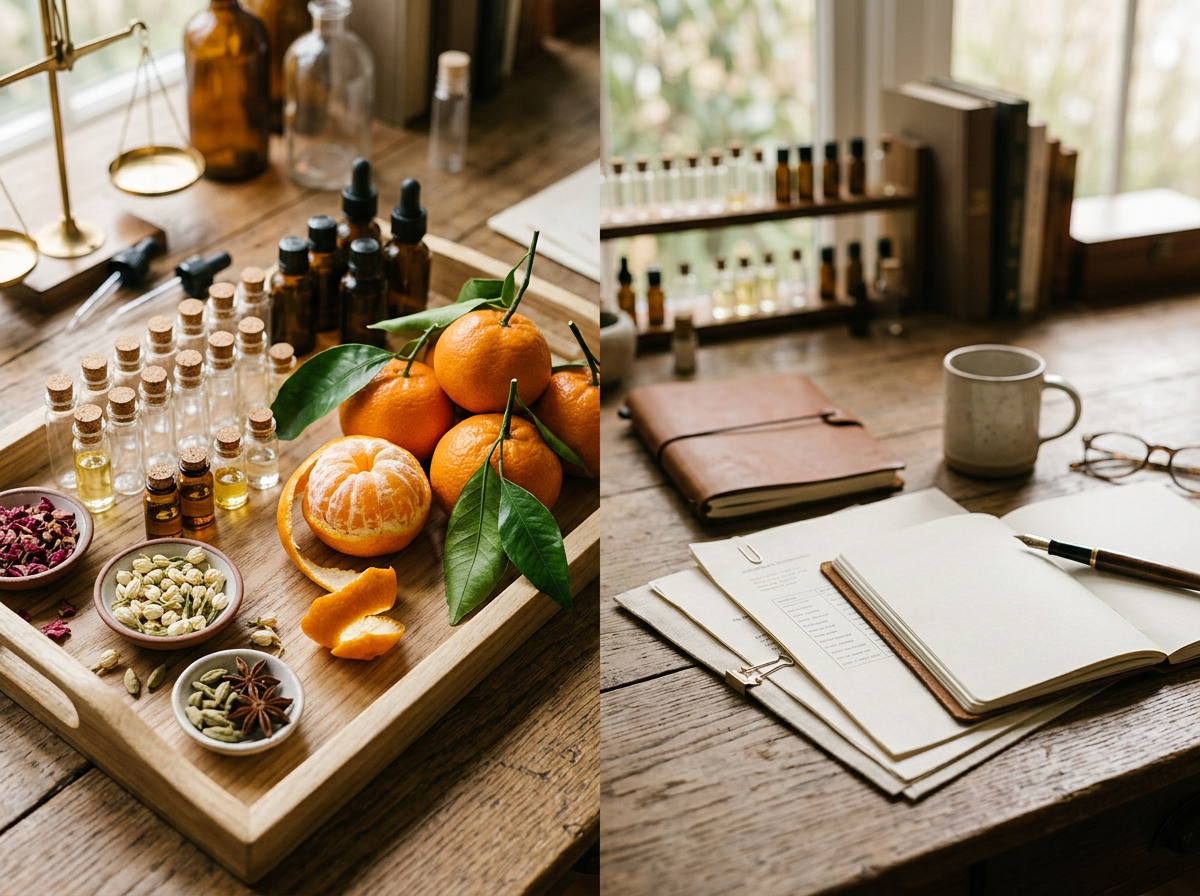
- Gather and label your materials. Before you open any bottles, set out your roller bottle, dropper or pipette, carrier oil, and all three essential oil bottles. Label each container clearly. Tangerine CO2 and tangerine essential oil can look identical in amber glass. Do not rely on memory mid-blend.
- Add the base note first. Drop 4 drops of Atlas cedarwood into the empty roller bottle. Building from base to top reduces the chance of the high-volatility citrus overtaking your nose before you can assess the blend accurately.
- Add the vanilla CO2. Vanilla CO2 in a jojoba dilution pours slowly. Tip the bottle at a 45-degree angle and allow 4 drops to fall. If your vanilla CO2 is undiluted resinoid, reduce to 1 to 2 drops; it is significantly more concentrated.
- Add the tangerine essential oil. Drop 8 drops of cold-pressed tangerine oil into the bottle. The blend will immediately smell very citrus-forward at this stage. That is expected.
- Smell before you fill. Hold the open bottle an inch or two from your nose without sniffing aggressively. Let the vapors drift to you. You are checking that the three notes register. If something feels off, now is the time to adjust before diluting with carrier.
- Add carrier oil. Fill the bottle to the shoulder with fractionated coconut oil, then cap and roll gently between your palms for 30 seconds to integrate.
- Rest the blend. Set it in a cool, dark spot for 24 to 48 hours. Essential oil blends, like a composed dish, settle and change after resting. Many blenders find the cedarwood comes forward beautifully on day two.
- Patch test before full use. Apply a small amount to the inside of your elbow and wait 24 hours before applying more broadly. Discontinue use if you notice any skin response.
Patch Testing and Safety Notes
- Photosensitivity: Cold-pressed tangerine oil contains furanocoumarins, which may increase UV sensitivity. Apply this blend only to skin that will not be exposed to direct sunlight or UV lamps for at least 12 hours. Steam-distilled or CO2-extracted tangerine oils carry a lower furanocoumarin load; check your supplier's GC/MS report if this is a concern.
- Children and pregnancy: This formula is designed for adults. If you are pregnant, nursing, or blending for young children, consult a qualified healthcare provider before use. Cedarwood essential oil is generally considered suitable for diffusion around older children, but dilution percentages for topical use on children should be reduced significantly (typically 0.5% or below for ages 3 to 6).
- Pets: Essential oils diffused in the home can affect pets, particularly cats, who metabolize certain aromatic compounds differently than humans. Ensure any space where you diffuse is well-ventilated and that animals can leave the room freely.
- Skin sensitivity: Vanilla CO2 in high concentration may cause sensitivity in some individuals. The 2% dilution here is conservative, but individual responses vary. Patch testing is always the first step.
- Not for internal use. This blend is for aromatic and topical (diluted) use only.
Storage and Shelf Life
Store your finished roller blend upright, away from heat and direct light. An amber or cobalt glass bottle offers meaningful UV protection. A dark cabinet or drawer is ideal.
Fractionated coconut oil is one of the more shelf-stable carrier oils available, with an oxidation timeline of roughly 18 to 24 months in proper storage. The limiting factor in this blend will be the tangerine essential oil, which is a cold-pressed citrus with a typical shelf life of 12 to 18 months from opening. Oxidized citrus oils smell flat, almost metallic, and may be more likely to cause skin sensitivity. If your blend stops smelling vibrant and bright, that is a reliable signal to mix a fresh batch.
For undiluted essential oils stored separately, keep them capped tightly, refrigerated if you have a dedicated oil fridge, and away from humidity.
Diffuser Version of the Sunrise Blend

The roller formula translates directly to a diffuser with a simple proportional adjustment. For a standard 100 ml ultrasonic diffuser:
| Ingredient | Drops |
|---|---|
| Tangerine essential oil | 5 |
| Vanilla CO2 (10% dilution) | 2 |
| Atlas cedarwood essential oil | 3 |
Run for 30 to 60 minutes in a ventilated room. Diffuse intermittently rather than continuously for the best aromatic experience. This blend is particularly well-suited to a morning diffusing ritual; for ideas on building that kind of routine, see our guide to a morning kickstart ritual with tangerine.
Variations on the Signature Citrus Blend
Variation 1: The Spiced Sunrise
Add 2 drops of cardamom essential oil to the standard roller formula (keeping everything else the same, and reducing carrier to maintain the 10 ml total). Cardamom adds a green, slightly peppery warmth that makes the vanilla note read richer. This variation suits cooler months particularly well.
Variation 2: The Coastal Morning
Swap the Atlas cedarwood for an equal measure of Ho wood essential oil. Ho wood (Cinnamomum camphora ct. linalool) is a soft, rosy-woody base note with a gentler character than cedarwood. The result is a lighter, more floral version of the Sunrise Blend, closer in feel to a spring morning than an autumn one. Ho wood is considered gentler on sensitive skin, though patch testing remains essential.
Variation 3: The Citrus-Forward Blend
Increase the tangerine to 12 drops and reduce the cedarwood to 2 drops. This version lets the citrus lead unambiguously. It is a brighter, more energetic blend, though expect the top note to fade faster than the standard formula. It pairs beautifully in a room spray: combine 12 drops tangerine, 2 drops vanilla CO2, and 2 drops cedarwood with 5 ml of high-proof alcohol (190-proof grain alcohol is the standard) and top with 5 ml distilled water in a 10 ml spray bottle. Shake before each use.
For those curious about working with tangerine oil beyond aromatics and personal care, our article on cooking with food-grade tangerine oil covers a completely different application of this beautiful citrus oil.
Making the Blend Your Own
The Sunrise Blend is a framework as much as it is a fixed formula. The 8-4-4 ratio of tangerine to vanilla to cedarwood is a reliable starting point, but blending is a personal practice. Keep a small notebook near your workstation. Write down every adjustment you make, including the date, the batch size, which carrier you used, and how the blend smelled on day one versus day three. That record becomes invaluable over time.
If your tangerine oil is particularly potent (a fresh bottle of a high-altitude variety, for example), you might find 6 drops sufficient. If your vanilla CO2 is a stronger concentration than 10%, start with 2 drops and build up. The formula is a guide. Your nose is the final authority.
One last note on quality: the three-ingredient simplicity of this tangerine vanilla blend means each component has nowhere to hide. A dull or oxidized tangerine oil will flatten the entire blend. A synthetic vanilla substitute will smell harsh against the wood note. Sourcing well is not optional here. It is the point.