DIY Tangerine Body Oil: A Sunny After-Shower Moisture Blend
There is something quietly satisfying about stepping out of a warm shower and reaching for a body oil you made yourself. You know exactly what is in it. You chose the carrier. You picked the citrus. And when that bright, sun-warmed scent rises from your skin, the whole morning feels a little more intentional.
This recipe builds a lightweight tangerine body oil designed for post-shower application on damp skin. The carrier oils absorb quickly without leaving a heavy residue, and the tangerine essential oil lends a cheerful, orchard-fresh top note that lingers softly through the first part of your day. If you have been curious about the Medina tangerine body oil style of blending (where the tangerine note stays front and center rather than buried under florals or musks), this is a good place to start.
Before You Begin: A Quick Note on Quality
The finished oil is only as good as what goes into it. For the tangerine essential oil, look for a cold-pressed version sourced from the peel, with a country of origin listed on the label. Medina-region citrus oils have earned a following among formulators for their consistent, round scent profile, but a reputable supplier anywhere will list the botanical name (Citrus reticulata) and the extraction method. Avoid any bottle labeled only as "fragrance oil" or "tangerine scent": those are synthetic and behave differently in skin formulations.
For carrier oils, fresh matters. Rancid carrier oil will undermine the whole blend. Smell your oils before you start. They should smell neutral to pleasantly nutty, never crayon-like or sharp.
Recipe Overview
| Detail | Info |
|---|---|
| Difficulty | Beginner-friendly |
| Prep Time | 10 to 15 minutes |
| Yield | Approximately 4 oz (120 ml) |
| Dilution Rate | 1% (face and sensitive skin) to 2% (body use on healthy adult skin) |
| Shelf Life | 3 to 4 months (see storage notes below) |
Ingredients
Carrier Oils
- 3 oz (90 ml) jojoba oil (technically a liquid wax; very stable, absorbs well, suits most skin types)
- 0.75 oz (22 ml) sweet almond oil (adds a slightly richer slip; skip if you have a nut allergy and substitute with sunflower or grapeseed oil)
- 0.25 oz (7 ml) rosehip seed oil (optional; adds a small amount of skin-conditioning fatty acids and a very light golden color)
Essential Oil
- 48 drops tangerine essential oil (this gives a 2% dilution in a 4 oz batch; reduce to 24 drops for a 1% dilution if your skin is sensitive or reactive)
Optional Additions
- 6 drops vanilla CO2 extract (rounds the citrus and adds a soft warmth)
- 6 drops bergamot essential oil (adds a gentle floral-citrus layer; use only bergapten-free bergamot if you plan to apply before sun exposure)
- 1 capsule vitamin E oil (approximately 400 IU, pierced and squeezed in) (acts as an antioxidant to help extend shelf life, not a preservative)
Equipment
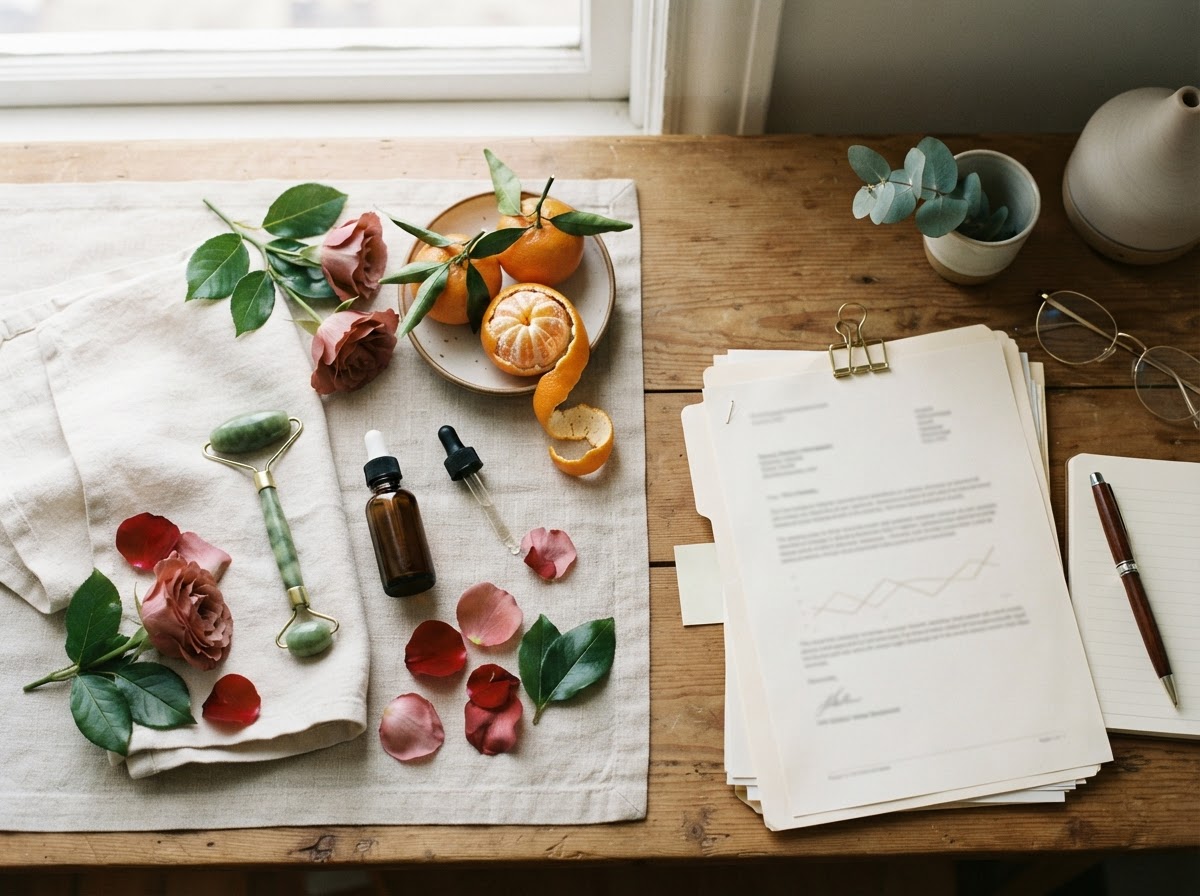
- One 4 oz amber or cobalt glass dropper bottle or pump bottle
- Small glass measuring cup or beaker
- Pipettes or a calibrated dropper (for essential oil accuracy)
- Funnel (optional, but helpful)
- Labels and a marker
Avoid plastic containers for storage. Citrus essential oils can interact with certain plastics over time, and glass keeps your blend stable and uncontaminated.
Step-by-Step Instructions
- Clean your workspace and equipment. Wipe down your glass measuring cup and the inside of your bottle with 70% isopropyl alcohol and let it air-dry completely. This removes any residue that could introduce unwanted microbes into your oil blend.
- Measure your carrier oils. Pour the jojoba oil into your glass measuring cup first, then add the sweet almond oil. If you are using rosehip seed oil, add it last. Swirl gently to combine.
- Add vitamin E (if using). Pierce one vitamin E capsule and squeeze the contents into the carrier oil blend. Stir slowly with a clean glass stirring rod or the back of a clean spoon.
- Count your essential oil drops carefully. Using a pipette, count 48 drops of tangerine essential oil directly into the carrier oil blend. If you are adding bergamot or vanilla CO2, add those now as well. Go slowly. Essential oils are concentrated and accurate drop counts matter for safety.
- Stir gently. Use your stirring rod to fold the essential oils into the carriers. Do not shake vigorously at this stage as that can introduce air bubbles and accelerate oxidation.
- Funnel into your bottle. Pour the finished blend into your amber glass bottle using a small funnel if needed. Cap tightly.
- Label immediately. Write the date of creation, the contents, and the dilution percentage on your label. You will thank yourself later.
- Do a patch test before full use. Apply a small amount to the inside of your forearm and wait 24 hours before applying all over your body. (See the safety section below for full details.)
How to Use Your Tangerine Body Oil
Apply 4 to 6 drops to damp skin immediately after stepping out of the shower, before fully toweling off. Damp skin absorbs body oil more efficiently than dry skin, and the water helps the oil spread farther with less product. Focus on areas that tend toward dryness: shins, elbows, and the backs of arms. Pat dry rather than rubbing.
The scent of tangerine in a body oil context is lighter than perfume. It is a daytime kind of fragrance: citrusy, fresh, and undemanding. People who find heavier floral or musk-forward oils overwhelming often find this diy citrus body oil style more wearable during warmer months.
Safety Warnings: Please Read in Full
Essential oils are potent botanical concentrates. They must always be properly diluted before skin contact.
Dilution Ratios
This recipe is formulated at a 2% dilution for general adult body use. This is the standard guideline from professional aromatherapy organizations for leave-on body products. For children over two years of age, a 0.5% to 1% dilution is more appropriate (12 to 24 drops per 4 oz batch). This blend is not formulated for children under two. If you are pregnant or nursing, please consult a qualified healthcare provider before using essential oil products on your skin.
Patch Testing
Apply a small amount (about 5 drops) to the inner forearm. Cover loosely with a bandage and leave for 24 hours without washing the area. If you notice any redness, itching, or other skin reaction, discontinue use. Even if you have used tangerine essential oil before, batch differences and individual skin changes mean patch testing each new blend is good practice.
Photosensitivity
Cold-pressed tangerine essential oil contains furanocoumarins, naturally occurring compounds found in citrus peel that can make skin more sensitive to UV light. Do not apply this body oil to skin that will be exposed to direct sunlight or UV tanning equipment within 12 to 18 hours. Use it as an evening ritual, apply it under clothing, or choose a steam-distilled tangerine oil (labeled as non-phototoxic) if daytime outdoor use matters to you. The same caution applies if you add bergamot that is not explicitly labeled bergapten-free.
Eye and Mucous Membrane Contact
Keep all essential oil blends away from eyes, the inside of the nose, and mucous membranes. If contact occurs, flush with a plain carrier oil (not water) and seek guidance from a healthcare professional.
Nut Allergy Note
Sweet almond oil is derived from tree nuts. If you have a known nut sensitivity, substitute it with sunflower, safflower, or grapeseed oil at a 1-to-1 ratio.
This product is for cosmetic and aromatic use only. If you have a skin condition or are under medical care, consult a qualified healthcare provider before adding new topical products to your routine.
Storage Instructions and Shelf Life
Store your tangerine body oil in a cool, dark location away from direct sunlight and heat sources. A bathroom cabinet works if your bathroom does not get overly steamy. The refrigerator is an option for extending freshness, though the oil may temporarily thicken in cold temperatures; bringing it to room temperature for a few minutes before use will restore its texture.
Without vitamin E added, expect a shelf life of roughly 2 to 3 months before the carriers begin to oxidize. With vitamin E, you can reasonably expect 3 to 4 months. Trust your nose. A blend that has gone rancid smells distinctly off, like old cooking oil or crayons. Discard and make a fresh batch.
Tangerine essential oil itself oxidizes faster than most other essential oils. Buy it in small quantities (10 ml to 30 ml) and store the unused portion tightly capped in the refrigerator.
Variations and Substitutions
The Earthy Citrus Variation
Replace the rosehip seed oil with marula oil, and add 6 drops of patchouli essential oil alongside the tangerine. Patchouli's deep, woody base note grounds the citrus brightness and extends the scent's staying power on skin.
The Lightweight Summer Version
Use 100% grapeseed oil as your carrier base (all 4 oz). Grapeseed is extremely lightweight, nearly weightless on skin, and absorbs very fast. It is ideal for humid climates or oily skin types. Increase the tangerine drops to 50 if you want the scent to carry through the thinner base.
The Medina Tangerine Body Oil Style Blend
For a profile closer to the Medina tangerine body oil aesthetic, keep the tangerine as your dominant note and layer in 4 drops of neroli essential oil (steam-distilled orange blossom). Neroli adds a honeyed, slightly green floral nuance without competing with the citrus. This combination has a classic Mediterranean character that suits both morning and evening routines.
Carrier Oil Substitutions at a Glance
| Carrier Oil | Best For | Texture |
|---|---|---|
| Jojoba | All skin types, long stability | Lightweight, non-greasy |
| Grapeseed | Oily or combination skin, hot weather | Very light, fast-absorbing |
| Sunflower | Dry skin, nut-allergy users | Light to medium |
| Fractionated coconut | Dry skin, humid climates | Light, long shelf life |
| Marula | Mature or very dry skin | Medium, silky finish |
What to Make Next
If this recipe sparked your interest in working with tangerine essential oil more broadly, there is a lot more ground to cover. Our complete guide to tangerine oil uses walks through aromatic, cosmetic, and household applications in one place. It is a useful reference to bookmark.
For something a little more focused, the DIY tangerine lip oil recipe uses a similarly simple method and produces a glossy, citrus-kissed lip conditioner you can make in about ten minutes.
And if you enjoy having that bright citrus scent follow you beyond the bathroom, the tangerine kitchen refresh guide covers how to build simple citrus-scented cleaning sprays that make everyday chores feel a little more pleasant.
A Few Final Thoughts on the Ritual
Homemade body oil has a kind of low-key appeal that commercial products sometimes miss. There is no elaborate process. The ingredients are straightforward. You mix them in a clean bottle, label it with today's date, and put it on the shelf where it will greet you every morning after your shower.
The tangerine note does a specific thing in a morning context. It is bright without being aggressive. It fades gradually and cleanly. People who have made this diy citrus body oil in its simplest form, just jojoba and tangerine, often report that the minimalism is the point. Nothing competes. The citrus gets to be itself.
Start simple. Adjust from there. Your next batch will be better informed by whatever you notice about this one.